

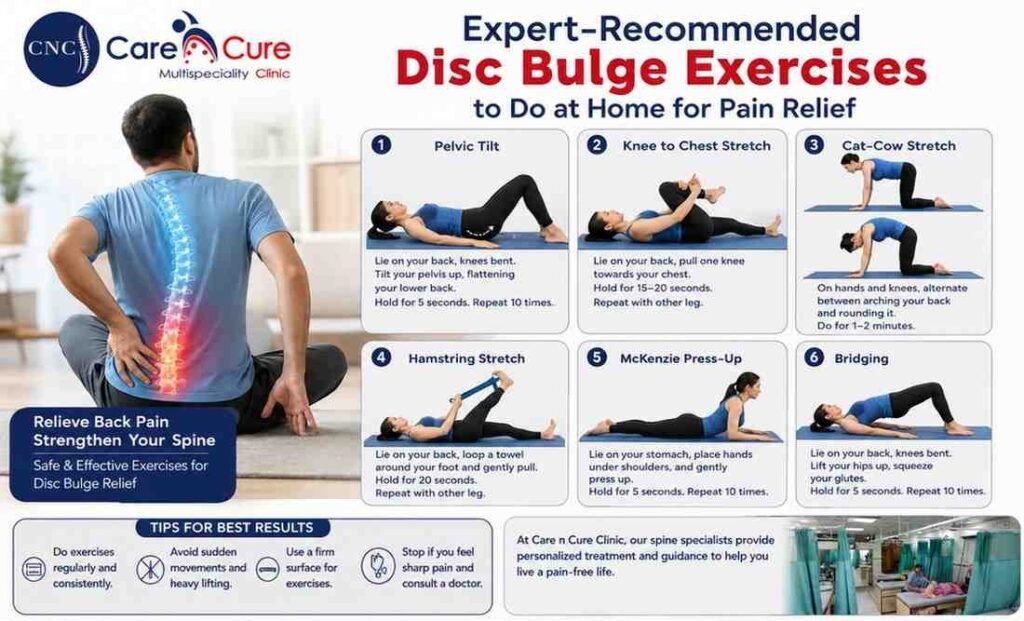
To a persistent disc bulge problem, immediate disc bulge treatment in Delhi is indeed available. However, if it is not that urgent, there are simple exercises suggested by experts that can be done at home to provide some relief.
Take a look at these exercises and notice what works for you. But if pain stays strong, seeing a professional needs to be prioritised for better recovery care and support.
Neck Extensions
A lot of people with disc injuries hold back from moving, fearing it’ll make things worse. But this gentle exercise helps wake up your neck muscles and reassures your body that movement is safe.
How to do it:
● Get onto your hands and knees comfortably, or use an exercise ball for support.
● Then, slowly arch your neck upward as far as you are comfortable and pain-free.
● Hold for 3 seconds, then return to a neutral, straight-neck position.
● Complete 10 repetitions, 10 times a day.
You have to perform this exercise slowly and in a controlled manner, and stop immediately if you experience any sharp, shooting, or radiating pain. However, if pain persists, go to a physiotherapist in Gopal Park.
Chin Tucks
Do you spend hours looking down at your phone or sitting in front of a laptop? There’s a good chance your neck is already carrying extra strain. Do this exercise to target the deep neck flexor muscles, which support your cervical spine and help keep your head in a better position.
How to do it:
● Sit in a comfortable position with your back straight and shoulders relaxed.
● Keep your eyes looking forward and gently pull your head backward.
● As you move your head back, your chin will naturally tuck in, creating a slight double chin.
● Hold this position for 3 seconds.
● Slowly return to the starting position.
● Repeat 10 times and perform the exercise throughout the day as recommended by your physiotherapist.
While doing this exercise, avoid tilting your head up or down. The movement should be gentle and controlled.
Joint Mobilization
Joint mobilization exercises are commonly recommended because they help improve movement between the cervical vertebrae and reduce stiffness that develops due to pain and inflammation.
How to do it:
● Roll a small towel and place it behind your neck.
● Hold both ends of the towel firmly with your hands.
● Gently pull the towel forward while performing a chin tuck.
● Hold the position for a second before relaxing.
● Return to the starting position and repeat 10 times.
● Perform 3 sets during the day.
Avoid pulling too hard on the towel. If you experience dizziness, numbness, or increased symptoms, stop immediately.
Scapular setting stretch
With scapular setting stretch, you get better posture, which can reduce unnecessary stress on your neck and help support long-term recovery.
How to do it:
● Sit or stand with your back straight.
● Place your fingertips lightly on your shoulders.
● Slowly roll your shoulders backward.
● Pull your shoulder blades down and together as if you are trying to place them into your back pockets.
● Hold the position for 10 seconds.
● Relax and repeat 10 times.
This exercise is particularly useful if you spend long hours at a desk.
Trapezius stretch (lateral stretch)
With a gentle trapezius stretch at the comfort of your home, you can release tension and improve flexibility.
How to do it:
● Sit or stand in a comfortable position with your shoulders relaxed.
● Slowly tilt your head toward one shoulder.
● Bring your ear as close to your shoulder as comfortably possible.
● Hold the stretch for 10 to 20 seconds.
● Return to the centre and repeat on the opposite side.
● Complete 2 sets on each side, 2 to 3 times a day.
Never force the movement, and stop if the stretch causes sharp pain or symptoms travelling down your arm.
Conclusion: When to Consult a Professional?
You must keep in mind that these movements can support flexibility, posture, and pain relief and are not a substitute for professional care.
If your pain continues, worsens, or starts affecting your daily, even simple, activities, it is time to seek a qualified physiotherapist in Gopal Park. They assess your condition and recommend the right disc bulge treatment plan for a safer, more effective recovery.

